
Here are some links in the press for Sudarshan Thirumalai’s
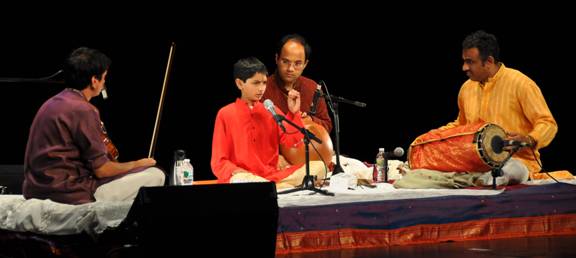
Carnatic Vocal Arangetram (debut), where he gave a 4 hour solo concert,
accompanied by the Mridangam (Indian
drums), Violin, and Ghatam (clay pot),
all played in the South Indian Classical Carnatic style.
The stringed instrument in the photo above is a tambura (drone) that is usually, but not
always, replaced by an electronic, synthesized version in today’s concerts.
Recently, on November 20, 2011, Sudarshan performed at the Sri Lakshmi Temple in Ashland,
Massachusetts.
If you are interested, you can read up more about Carnatic
Music here
Details about the Mridangam, Ghatam and Tambura can be found
here
And if you were curious about whether Western and Indian
classical music are related, you might enjoy reading the following excerpt:
India
was the original source of Western Classical music, although there now are
similarities as well as differences. Yehudi Menuhin, the greatest Western
Violinist of the 20th century, brings this out in his book “Unfinished Journey”
..
“Despite predisposition in India’s favor,
I have to acknowledge that Indian music took me by surprise. I knew neither its
nature nor its richness, but here, if anywhere, I found vindication of my
conviction that India
was the original source. The two scales of the West, major and minor, with the
harmonic minor as variant, the half-dozen ancient Greek modes,were here
submerged under modes and scales of (it seemed) inexhaustible variety. Even the
arcane rules of dodecaphonic composition had been anticipated and surpassed,
for where the dodecaphonic system requires- somewhat arbitrarily, in my view -
all twelve notes to be sounded in a given sequence and forbids their repetition
within it, any given Indian raga chooses five or six notes, never more than
seven or eight, while the hundreds of ragas between them exploit all possible
notes in permutations of a subtlety and flexibility we can scarcely conceive.
Melodically and rhythmically Indian music long ago achieved a complex
sophistication which only in the twentieth century, with the work of Bartok and
Stravinsky, has Western music begun to adumbrate.”
If you are interested, you can read more about it here...